Meet the creative director carving a feminine signature at the fabled fashion house
Sarah Burton is a great designer. And she is a woman. This detail should not make her remarkable. But, in fact, she is. Women currently hold only 12 to 14 per cent of top creative director jobs at major fashion houses. And Burton, who is the creative director of Givenchy, is one of only four such female creative directors within LVMH, the luxury conglomerate group that owns 75 maisons.
Burton was appointed to the Parisian house, founded by Hubert de Givenchy, in 2024. She is 51 – another unusual detail in an industry obsessed with youth. Previously, she had spent her whole career at Alexander McQueen, where she arrived as an intern in 1996 while studying at Central Saint Martins. She became Lee McQueen’s right-hand woman and was named his successor following his death in 2010, leading the house until 2023, when she announced her resignation.
Her role at McQueen was part custodian, part innovator. She continued to develop his brand of firebrand femininity, sharp tailoring and exquisite handcraft skills. Even when designing the gown worn by the Princess of Wales for her wedding in 2011, Burton still deferred to her late mentor. One day, though, “something shifted”, reflects the designer. “My dad died, in the April, and I resigned a few months later. There was closure. I felt like I’d done what I needed to.”
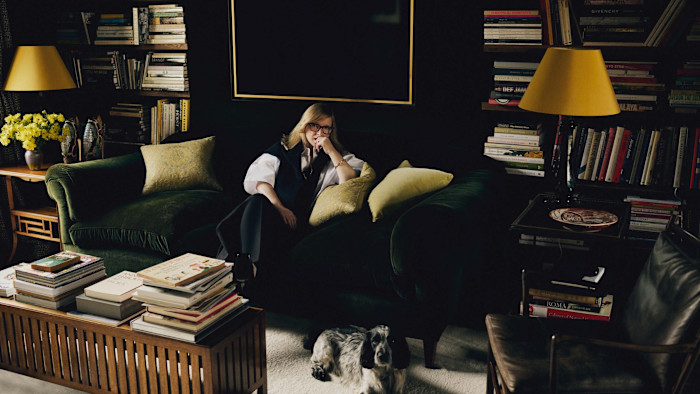
Burton is sitting on a deep-green corduroy sofa in the reception room of her house in St John’s Wood. She moved to the area with her husband David, a photographer, in 2011. “I’ve always loved it here,” she says. “It’s kind of hidden.” Her neighbourhood is one of the more genteel postcodes in north London, quiet and furnished with scores of well-appointed Georgian homes. Downstairs in the large open-plan kitchen is a row of birthday cards; her twins, Cecilia and Elizabeth, have just turned 13, while youngest daughter Romilly is nine. The twins marked their move into adolescence with a tufting workshop party where they all made mini rugs. Burton flicks through pictures on her phone to show off their craft skills, confessing that she was forbidden from overseeing their designs.
Upstairs, the living room is split into two spaces. The lounge side is framed by a huge portrait by the Dutch photographer Hendrik Kerstens. By the window, a table serves as a home office, piled with fashion books. A mannequin dressed in an embellished bustier minidress – look 29 from Givenchy AW25 – stands sentry by the window. A netball lies abandoned on the floor. Burton is dressed “like a school teacher”, she says dismissively of her appearance, in her working uniform of jeans and a white shirt. A grey sweater is tied around her shoulders and her blonde hair is cut in a sharp mid-length bob. She speaks with the faintest trace of a northern accent.
Her exit from McQueen was prompted also by her upcoming 50th birthday – an anniversary that can throw one’s career prospects into keen relief. “Exactly,” says Burton. “I just had this sense of now or never. Everything’s good. But is there anything else?”
Burton left the brand “without any agenda” and set herself up in a tiny studio in west London. “It was like walking off a cliff,” she says. “I didn’t know what was going to happen. I didn’t have something to go to. I was like, I’m just going to stop for a bit and reassess what I’m about and what I really love. What’s good, when you’re not in the system for a minute, is that you work out what you miss.” And Burton realised very quickly that she missed “making clothes”.
Arguably, at Givenchy, Burton has joined another house in thrall to a male vision – and an exacting vision at that. Having opened his studio in 1952, Hubert de Givenchy parlayed a brand of unparalleled refinement until his retirement in 1995. His taste was best expressed by friends and clients such as Audrey Hepburn, Jacqueline Kennedy Onassis and “Bunny” Mellon, the Listerine heiress for whom he created an entire wardrobe according to her dictum that “nothing should be noticed… Nothing should stand out”. He was drawn to fabulous women who, he once said, were “spoilt by a marvellous life”.
Even so, Givenchy has much changed in the interim. A succession of designers have grappled with his legacy, including Clare Waight Keller, Riccardo Tisci and, for five years from 1996, Lee McQueen (who scandalised the French establishment with his debut couture collection of golden-horned headdresses and plasticky winged corsetry in a show inspired by the myth of the Argonauts). Its fortunes have waxed and waned in the past decade: LVMH does not break out individual earnings for Givenchy but analysts put brand revenues between €500mn and €700mn a year. Sidney Toledano, the former CEO of LVMH Fashion Group (now special adviser to Bernard Arnault), once described the house as being his “problem child”.
Delphine Arnault, the Dior CEO and chairman (who sits on the executive committee of LVMH), was instrumental in Burton’s appointment. “I thought she would be a perfect match with Givenchy,” she writes. “She is a true couturier, her pieces are a work of art and the cut is so precise. To my mind, Mr de Givenchy would be thrilled to have Sarah continue his legacy.”
In order to empower a “new vision”, Amandine Ohayon was appointed CEO in January. “It’s been incredibly exhilarating,” says Ohayon. “There’s a collective ambition to bring Givenchy back to the prominent place it so deserves. We hit it off in our first meeting. We move quickly and tackle challenges head on. We are incredibly aligned on where we want to go.”
Givenchy’s inconsistent recent history is to Burton’s advantage; with the new team, she can refine her vision and write her own signature. Her first collection in March 2025 was a nice apéritif: respectful, accomplished, possibly a little overthought. Her second, in October, was looser and more confident. A smart edit of twisted tailoring, sensual gestures that revealed the body and “bed-sheet” dresses, it was well-executed, wearable and played with chic female archetypes.
“Often as a designer, the first question you get asked is ‘Who’s your woman?’ And that makes women sound like they’re just one type of thing,” Burton says. “For me the point is how do you dress those moments in a woman’s life where she needs to feel a certain way? How do you empower a modern woman with the jeans that she wears, or the jumper, or the great big red-carpet thing? How do you dress a woman that makes her feel amazing but doesn’t overwhelm?”
Burton is a passionate “dressmaker”. She is rigorously hands-on. “The first thing I did at Givenchy was go to the ateliers and unwrap and pick apart the tailoring,” she says. “The first season was basically about ‘How do you make the clothes?’ And then the second season I was like, ‘OK, now we’re going to make all the women’s tailoring in the menswear atelier.’” Far from being masculine, however, the SS26 collection was femme. “I’m fascinated by the sensuality of women,” says Burton. “How they want to feel sexy but they don’t want to be vulgar. The second collection was really about celebrating women in their bodies. A celebration of women.”
“What makes Sarah exceptional is her extraordinary attention to detail combined with her genuine kindness,” says Kaia Gerber, the model with whom Burton has shot three campaigns at Givenchy and one at McQueen. “Everything she creates comes from the heart. What makes her pieces special is that they don’t impose an identity, they reveal one. Her work always seems to meet me exactly where I am.”
If Burton does have the trait of an educator, it’s in the way she shares. She’s keen that you understand her process. She asks questions and wants opinions – an interview becomes, somewhat shamefully, a conversation of equal parts. She moves towards the table on which she has a printout of images showing Hubert de Givenchy’s first collection from 1952: 20 or so images that have helped inform her moodboard. “Not literally, of course,” she says. “But look at this silhouette…” She motions to a picture of a woman in an opera coat with a trapezoid silhouette. She then holds up her own modern interpretation – a leather tracksuit with the same bold sweeping lines. The image sits happily with the vintage pictures. “You see,” she smiles. “It doesn’t look out of place.”
On the same table is a spill of sketches – various couture ideas that have come to mind. She draws constantly. “Sometimes I have weird dreams and I’m like, ‘Oh my God, I should keep a sketchbook by my bed.’” Givenchy retains a “very tiny” couture atelier that dresses private clients; see the Princess of Wales in a custom red gown at the state banquet for French President Emmanuel Macron at Windsor Castle last summer, or Doechii at the Grammys, or Jennifer Lawrence in a sheer floral embroidered gown at this year’s Golden Globes. Working directly with clients is a huge source of inspiration: a couturier must be a dressmaker, but also confessor and therapist. “You develop very strong relationships,” says Burton. “You pick up the phone, send them pictures, you talk to them. I love going to fittings for clients or celebrities because you learn how the clothes are in real life.”
One day, she will stage a couture show (“maybe next summer, 2027”) but for now she has other priorities. Namely, menswear. “Men are completely different in the way they look at fashion and understand it. It’s more about the wardrobe. More garment by garment,” she says. “Do you know what I love about men’s fashion? I think it feeds the women’s. I haven’t done a men’s show yet – I think that will be in June – but I like the conversation between the two collections. And I really love the tailoring.”
She brought Harley Hughes from McQueen to work with her on menswear, and has made custom suits for Paul Simonon and Timothée Chalamet. “I love the fact that Timothée can wear a leather tracksuit,” she says of her Givenchy muses, “and he can wear a tailored suit and still be him because he really understands who he is.”
Sarah Jane Heard was born in Macclesfield in 1974, the second of five children, and spent her childhood there. Her family were artistic, but Burton laughs when I ask whether she was the child who schlepped to the village store to buy Vogue magazines or saved up her pocket money to buy designer clothes. “I was very uncool,” she says, not for the first time. “I wasn’t from a very fashiony family at all. I just loved drawing and then I had a great art teacher – it’s always about one teacher, isn’t it? – and she got me into fashion. Well, I knew I wanted to do fashion, but she was like, ‘You need to get some art in as well.’”
She came of age at “the tail end of the Haçienda era”, the epicentre of Manchester’s rave scene, “so I could pretend it was a major influence…” she grins. Some of her earliest fashion references were Richard Avedon’s pictures for Versace – “those dresses, incredible” – and style references that she gleaned from films.
Films are a major reference at Givenchy. The founder created Hepburn’s wardrobe for Breakfast at Tiffany’s, Funny Face and Sabrina, among others. He dressed Ingrid Bergman, Marlene Dietrich and Grace Kelly too. “That’s the great thing about Givenchy, people know it through film,” says Burton. “And I really related to that, because it was through film that his relationships were so strong.”
When asked about the most important facet of her work, however, she says it’s management that counts. “I know it sounds like a cliché, but work is literally about people. Our job – every job – is about team management.”
Another teacherly habit: she likes the design process to be totally transparent. “The first thing I did [at Givenchy] was knock the walls down because everyone was working in their tiny little rooms. And I was like, I want my embroidery person to see what the leather people are doing… I like a very democratic way of working. I don’t like anybody hiding anything. It’s what I did with Lee when we set up the studio. Everything was open, it was all on the walls. Everybody could see what everyone else was doing, and it fed everybody else. For example, Harley brought me this little tiny button they’d found in the market, like a raspberry, the other day. I gave it to the shoe people, so they can make a shoe. I feel that’s the most creative way to work, and then more people feel involved. It becomes a passion rather than a job.”
If Burton has a weakness, it’s a tendency to get bored. She doesn’t like to look at something for too long. If she spends too much time with a collection or, God forbid, takes a holiday and returns to it a month later, her impulse is to start again. She’ll often rethink a look at the last minute if, in the fitting, it transpires that a model “isn’t comfortable wearing heels. Sometimes it comes to the fitting and I say to the model, ‘I’ll just make you something else.’”
It’s a month before her AW26 collection, the bulk of which should now be done. Does she feel ready? “No! I’m going to change it all tomorrow. No, I’m joking. Well, I’m probably joking,” she grins insouciantly.
In the past two years, Burton’s life has undergone a major upheaval. She now travels to Paris several times a week; although Givenchy maintains a small studio in London, she likes to be in the main HQ, around the atelier staff. She finds the commute on the Eurostar quite grounding. Coming back to three daughters, with their netball matches and their emerging opinions and hobbies far removed from fashion, keeps things “real”.
Not that she needs much of a re-orbit. Burton is one of the realist (and real-est) designers. She’s unerringly human. At one point she tells the story of how in 2011, in preparation for the Savage Beauty-themed Met Gala in honour of Lee McQueen, she had to dress dozens of people for the red carpet, a cavalcade of hauntingly fantastical designs. In all the urgency and chaos, she had forgotten to bring anything for herself. “I literally hadn’t organised anything to wear at all because I’d been doing everyone else’s look. So I ended up going to a shop and got a dress. Off the rack.”
Surely, among all her extraordinary creations, Burton must have a stash of flouffy dresses that she sometimes takes out for a whirl? Indeed, there is an archive. “But I never wear them,” she laughs. “I’ve got a beautiful wedding dress that Lee made for me. It was the dress with the horns from the Widows of Culloden collection. That dress was inspired by my wedding dress – although I didn’t have the horns. Lee would often give me dresses or other things, and when I was younger, I did wear them. And I do think it’s important to wear the clothes. I wear the jackets and the shirts. I think it’s important to put it on, to feel how it feels.”
Sarah Burton is a designer. And she is a woman. But perhaps her rarest quality is how incredibly, magnificently normal she remains. I want to hang out with her for the weekend, keep chatting and do a tufting workshop. Because, contrary to what she might tell you, Sarah Burton is really very cool.