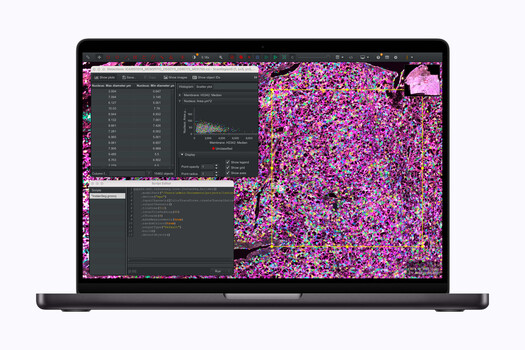
Apple’s M5 Pro and M5 Max MacBook Pro models deliver 4x faster AI performance, doubled SSD speeds up to 14.5 GB/s, and base storage starting at 1TB and 2TB respectively. Key upgrades focus on on-device AI capabilities.
Apple has announced the updated 14-inch and 16-inch MacBook Pro with the M5 Pro and M5 Max chips, marking a significant generational update focused heavily on AI performance and storage.
What’s New Under the Hood
The M5 Pro and M5 Max are built on what Apple is calling “Fusion Architecture,” which combines two 3 nm dies into a single system on a chip. Both chips feature an up-to-18-core CPU architecture that includes six “super cores” (Apple’s new branding for its highest-performance cores) and 12 performance cores. There are no longer efficiency cores in the traditional sense. Apple says this delivers up to 30 percent faster CPU performance for pro workloads compared to the M4 Pro and M4 Max, and up to 2.5 times higher multithreaded performance versus M1 Pro and M1 Max.
The M5 Pro pairs that CPU with an up-to-20-core GPU, while the M5 Max scales to an up-to-40-core GPU. Each GPU core now includes a Neural Accelerator, which Apple says is the key driver behind the AI performance gains. Combined with a faster 16-core Neural Engine and increased unified memory bandwidth, Apple claims up to 4 times faster AI performance versus M4 Pro and M4 Max, and up to 8 times faster versus M1 models. Specific claims include up to 4 times faster large language model prompt processing and up to 3.8 times faster AI image generation compared to M4 Max.
The GPU also gains an enhanced shader core with second-generation dynamic caching, hardware-accelerated mesh shading, and a third-generation ray-tracing engine. Apple claims up to 35 percent faster ray tracing on M5 Pro versus M4 Pro and up to 50 percent higher overall graphics performance across both chips compared to their predecessors.
On the memory side, M5 Pro supports up to 64 GB of unified memory with up to 307 GB/s of bandwidth (up from 48 GB and 273 GB/s on M4 Pro). M5 Max supports up to 128 GB with up to 614 GB/s (up from 546 GB/s on M4 Max).
SSD performance has doubled. Apple says read and write speeds now reach up to 14.5 GB/s, and base storage has been increased: M5 Pro models now start at 1 TB, while M5 Max models start at 2 TB.
The machines also include Apple’s N1 wireless chip, which enables Wi-Fi 7 and Bluetooth 6.
Configurations and Pricing
The M5 Pro is available in two configurations: a base option with a 15-core CPU, 16-core GPU, and 24 GB of unified memory, and a higher-tier option with an 18-core CPU, 20-core GPU, and up to 64 GB of memory. The M5 Max starts with an 18-core CPU and 32-core GPU, with an upgrade path to a 40-core GPU and up to 128 GB of unified memory.
Here’s the pricing breakdown:
14-inch MacBook Pro with M5 Pro: starts at $2,199
16-inch MacBook Pro with M5 Pro: starts at $2,699
14-inch MacBook Pro with M5 Max: starts at $3,599
16-inch MacBook Pro with M5 Max: starts at $3,899
All models come in space black and silver.
Everything Else
The physical design is unchanged from the previous generation. The Liquid Retina XDR display remains the same, with 3,024 by 1,964 resolution on the 14-inch and 3,456 by 2,234 on the 16-inch, ProMotion up to 120 Hz, 1,600 nits peak HDR brightness, up to 1,000 nits SDR, and an optional nano-texture finish. Connectivity includes three Thunderbolt 5 ports, HDMI (up to 8K), an SDXC card slot, a 3.5 mm headphone jack with high-impedance support, and MagSafe 3. The 12 MP Center Stage camera, six-speaker sound system with Spatial Audio, and studio-quality microphones carry over as well.
Battery life is rated at up to 24 hours of video playback. Apple says fast charging reaches 50 percent in 30 minutes using a 96 W or higher USB-C adapter. M5 Pro supports up to two external displays, and M5 Max supports up to four.
The machines ship with macOS Tahoe, which introduces the Liquid Glass design language, expanded Spotlight capabilities, and Apple Intelligence features.
Apple also notes that the MacBook Pro is made with 45 percent recycled content, including 100 percent recycled aluminum in the enclosure and 100 percent recycled cobalt in the battery.
Key Specs at a Glance
M5 Pro:
CPU: up to 18 cores (6 super cores, 12 performance cores)
GPU: up to 20 cores with Neural Accelerator in each core
Neural Engine: 16 cores
Unified memory: up to 64 GB
Memory bandwidth: up to 307 GB/s
Base storage: 1 TB
M5 Max:
CPU: up to 18 cores (6 super cores, 12 performance cores)
GPU: up to 40 cores with Neural Accelerator in each core
Neural Engine: 16 cores
Unified memory: up to 128 GB
Memory bandwidth: up to 614 GB/s
Base storage: 2 TB
Shared specs (both chips):
Display: Liquid Retina XDR, ProMotion (120 Hz), up to 1,600 nits peak HDR, nano-texture option
Connectivity: 3x Thunderbolt 5, HDMI (8K), SDXC, 3.5 mm headphone jack, MagSafe 3
Wireless: Wi-Fi 7 and Bluetooth 6 (Apple N1 chip)
Camera: 12 MP Center Stage with Desk View
Audio: six-speaker system with Spatial Audio, studio-quality mics
Battery: up to 24 hours video playback
SSD speeds: up to 14.5 GB/s (up to 2x faster than previous generation)
Colors: space black, silver
OS: macOS Tahoe
Why This Matters for Photo and Video Creators
For photographers, the doubled SSD speeds and increased base storage are immediately practical. Importing and working with large batches of raw files or catalogs in Lightroom and Capture One should feel noticeably faster, and starting at 1 TB means fewer compromises out of the box for anyone maintaining sizable image libraries.
Video editors stand to gain even more. The up to 50 percent increase in GPU performance and significantly higher memory bandwidth matter for real-time timeline scrubbing and effects rendering in applications like DaVinci Resolve, Final Cut Pro, and Premiere Pro, especially when working in 4K or 8K. Apple specifically claims up to 5.4 times faster video effects rendering in DaVinci Resolve Studio compared to M1 Max, and up to 3 times faster than M4 Max. The M5 Max MacBook Pro’s 128 GB unified memory ceiling also means that users working with multiple streams of high-resolution footage or color grading workflows have more headroom before needing to offload work to a desktop.
The AI performance gains are also relevant here. Topaz Video AI, a popular tool among video creators for upscaling and noise reduction, is claimed to run up to 3.5 times faster on M5 Max versus M4 Max. For photographers using AI-powered tools for masking, noise reduction, or generative fill, the Neural Accelerators in every GPU core should accelerate those tasks. The ability to run large language models locally is more of a developer and researcher feature, but it signals the direction Apple is pushing these machines.
Thunderbolt 5 across all models is a meaningful addition for anyone working with high-speed external storage arrays or multiple high-resolution displays. And for studio or field use, the unchanged 24-hour battery life means these machines remain viable for extended shoots or location editing without a power outlet.
Wrapping Up